
If you searched for is IPTV illegal in Canada, you probably found answers that contradict each other. Some pages call IPTV completely legal and others call it piracy. Both can be partly right, because “IPTV” describes how TV reaches your screen, not who has the right to sell it. Once you separate the technology from the service, the picture becomes much clearer. This IPTV Canada 2026 guide covers what viewers can check for themselves.
Want to Test Before You Decide?
Strong 8K IPTV offers a 12-hour trial and a 7-day refund window. Check the plans, then test on your own screen.
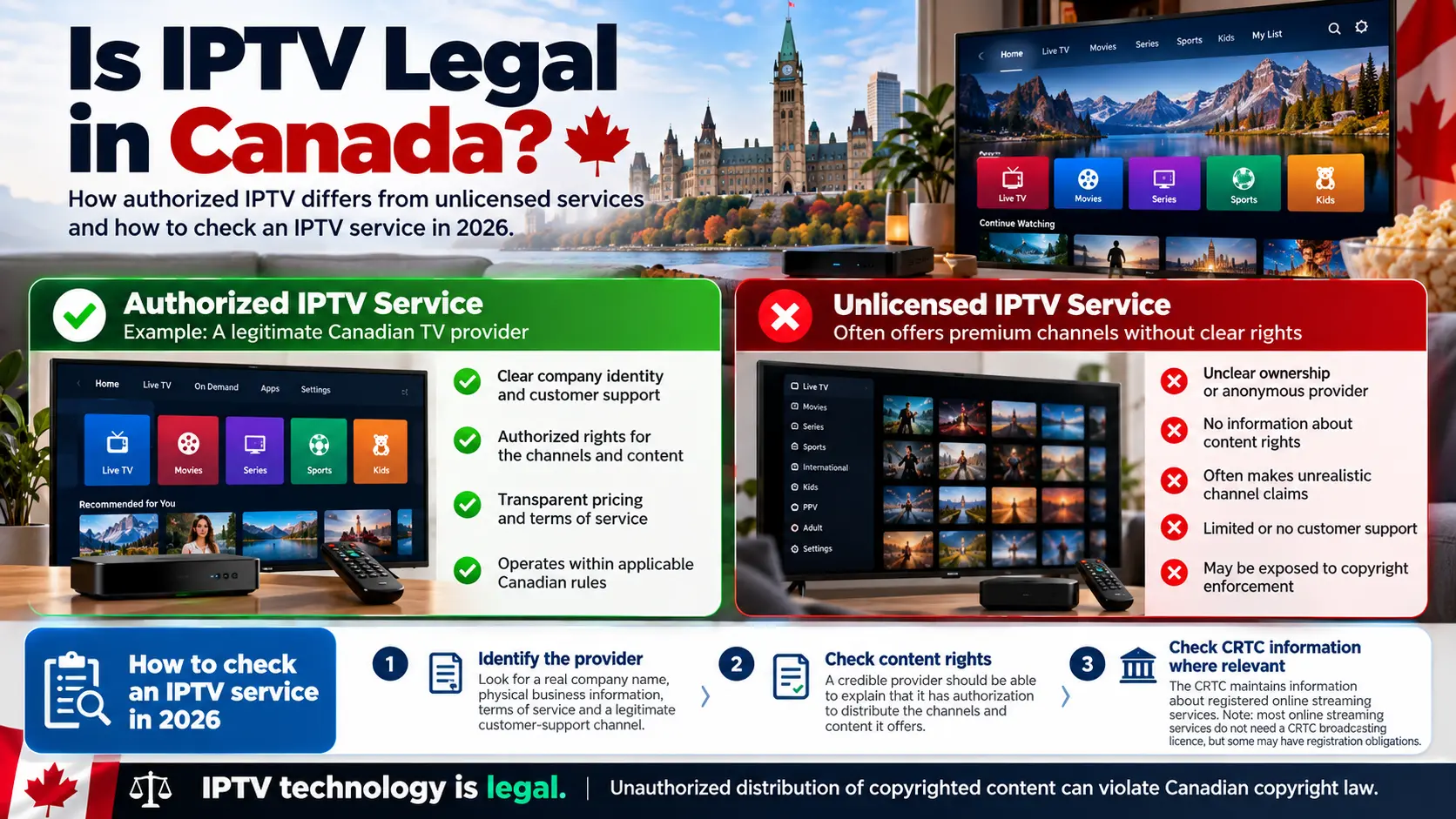
The Short Answer: Is It the Technology or the Service?
IPTV stands for Internet Protocol Television. IPTV delivers live channels, movies and series over an internet connection instead of a cable or satellite line. Nothing about IPTV technology is against the law, and Canadian companies sell IPTV openly.
The legal question is about content. TV programs, films and live broadcasts are protected by copyright, so a seller needs permission from the rights holders to offer them. A service with that permission is licensed. A service without it is not. When people ask whether IPTV is illegal in Canada, they are really asking whether a specific service has the rights to what it sells.
That is why a Canadian IPTV subscription from a large TV provider and an anonymous website selling thousands of channels can both be called “IPTV” and still sit on opposite sides of the law. Quality Canadian IPTV starts with a seller that can explain where its content comes from. Content rights are the foundation of live TV in Canada.
IPTV in Canada: Bell Fibe TV and Canadian IPTV Services
IPTV services work like this: IPTV sends video as a stream of data over your home internet, and your TV or streaming device turns that stream into a picture. Large Canadian providers offer TV services, including IPTV, and Bell and Telus are examples. Independent IPTV sellers offer subscriptions too. Across Canada you will meet IPTV in three forms.
| Where you see it | What it is | Legal status |
|---|---|---|
| Provider TV services | Bell Fibe TV is an IPTV service, available since 2010. Telus began offering IPTV in select Alberta communities in 2005. | The provider licenses its content. The technology is not in question. |
| Independent IPTV services | Websites that sell a subscription. Canadian IPTV services typically send you a server address, a username and a password. | Depends on whether the seller holds the rights to the content. |
| Player apps | An IPTV app such as TiviMate or IPTV Smarters plays the streams you add to it. | An app is a player. The content comes from the service you connect. |
Broadcasting and telecommunications in Canada are regulated by the Canadian Radio-television and Telecommunications Commission (CRTC). Established TV providers operate under clear rules about the content they carry, while IPTV services sold by independent websites are a different kind of business.
Licensed IPTV or Unlicensed IPTV: What Is the Difference?
Most buyers cannot read a service’s contracts, but they can look for signs. IPTV providers in Canada range from household names to anonymous websites. This table shows what a legitimate seller normally looks like and which warning signs suggest you should ask more questions.
| Check | Licensed service | Warning signs |
|---|---|---|
| Content rights | The seller can say which rights it holds and answers when you ask in writing. | No answer, a vague answer or a refusal to put anything in writing. |
| Seller identity | A real business name, contact details and a terms page. | No company name, no terms and no way to reach anyone. |
| Payment | Clear payment options, at least one with a dispute process, and a written refund policy. | Only one-way payments such as gift cards or wire transfers, with no refund policy. |
| Pricing | Clear prices, including what you pay at renewal. | Prices that change after payment or hide the renewal cost. |
| Support | A way to ask questions before and after you buy. | Questions go unanswered until you pay. |
| Promises | Realistic claims about quality and availability. | Absolute claims such as “100% uptime” or “never buffers”. |
None of these signs proves that a service is legal or illegal on its own. Together they help you decide whether an IPTV seller deserves your money, and they are the reason the check later in this guide starts with the seller. Premium IPTV pricing does not guarantee licences either, and a large channel count does not prove them. Judge the seller, not the price.
IPTV vs Cable and Satellite TV in Canada: What Changes for You
Cable and satellite TV reach your home over a dedicated network or from a dish. IPTV reaches Canadian households over the internet connection they already pay for. For a viewer thinking about cord-cutting, three things change.
- Your connection matters. The quality of your broadband internet affects the picture as much as the TV service does.
- You choose the device. With an independent seller you pick a smart TV, a streaming stick or another device instead of using one provider’s equipment.
- The seller matters more. A provider TV service and an independent seller’s offer can look alike on screen and still be very different businesses.
What Canadian Courts Have Done About Unauthorized IPTV
Canada and IPTV meet in court mostly when rights holders ask the Federal Court for blocking orders, and three orders show how the system works.
In Teksavvy Solutions Inc. v. Bell Media Inc. (2021 FCA 100), the Federal Court of Appeal upheld Canada’s first site-blocking order. The order required nine Canadian ISPs to block access to websites linked to GoldTV, an unauthorized IPTV service, for two years. To obtain it, the rights holders had to show a strong prima facie case of infringement.
In Rogers Media Inc. v. John Doe 1 (2022 FC 775), the Federal Court went a step further and issued a dynamic blocking order aimed at unauthorized live sports streams. “Dynamic” means the list of blocked servers can change as new ones appear, so the blocking can follow the stream. An independent agent identified the addresses to block, and an independent expert reviewed how the order worked.
In July 2026, the Federal Court (Justice Southcott) issued a new site-blocking order in court file T-1127-26. The applicants included Rogers Media, Groupe TVA and several major film studios. The order names 13 services, six of them IPTV services, and requires Canadian ISPs including Bell, Rogers and Telus to block them for two years. It also adds a simplified procedure: rights holders can ask to add new domains linked to the same services, and if no ISP objects within five business days, the update takes effect without a further hearing.
All three orders targeted services and were carried out by internet providers. None of them banned IPTV itself, which answers a common question: Canada does not block IPTV as a technology. Courts block specific websites and servers when rights holders prove their case, and the process has become faster and more flexible over time. For a customer, the practical lesson is that a service tied to a blocked site can stop working, whatever you paid for it.
Can You Get in Trouble for Using an IPTV Service in Canada?
This is the question most viewers care about most, and it is the one this guide cannot answer for you. The orders above were aimed at services and internet providers, not at viewers. How copyright law applies to an individual viewer is debated, so ask a lawyer if you need a firm answer.
What you can understand is the notice system. Under Canada’s notice-and-notice regime, copyright owners can send a notice to your internet provider, such as Bell, Rogers or Telus, and the provider forwards it to the account holder. According to the Office of Consumer Affairs at Innovation, Science and Economic Development Canada:
- Receiving a notice does not necessarily mean you have infringed copyright or that you will be sued.
- A compliant notice must not demand payment or personal information.
- The regime does not impose obligations on the subscriber who receives a notice.
If you receive a notice, read it carefully and speak to a lawyer if you are unsure what it means for you.
Is an IPTV Box or Android Box Legal in Canada?
Set-top boxes and sticks such as a Fire TV Stick are general-purpose devices that run video apps. Owning one is not the legal issue. The service and the content you connect to it are.
That also tells you what to ask when you buy a box that comes with software already installed: what is installed, who supplies it and whether the seller can explain where the content comes from. A box is only as legitimate as the service behind it.
Best IPTV Canada Service: Four Questions to Ask Before You Choose
Choosing an IPTV service is easier with a short checklist. Before you use IPTV for the first time, ask these questions. They help you find the best IPTV Canada has to offer, whichever provider you are considering. There is no single best IPTV service in Canada for everyone, but the right choice is one that answers them clearly. A reliable IPTV provider is happy to answer them, and IPTV users who ask them are better placed to avoid the problems described above. If a seller avoids them, treat that as useful information.
Who Is the Seller?
Look for a real business name, a contact page and written terms. Send a question before you buy and see how quickly someone answers. A real business answers questions before you pay.
Where Does the Content Come From?
Ask whether the provider holds the rights to what it sells, which licences it holds and ask for the answer in writing. A seller that holds the rights can explain them. A seller that cannot is telling you something.
How Do You Pay?
Know how each payment method works. Some, such as PayPal, let you open a dispute with the payment provider. Money transfers and cryptocurrency are generally hard or impossible to reverse once sent, so test the service and read the refund terms first. Confirm the price in Canadian dollars that you pay today and the price you pay at renewal.
Can You Test It First?
Ask whether there is a free trial or a refund policy, and read the terms before you pay. The sections below show how we answer, and what to look for in any trial.
How Strong 8K IPTV Answers the Four Questions
We ask you to put these four questions to every provider, so here is how we answer them.
| Question | Strong 8K IPTV |
|---|---|
| Who is the seller? | Strong 8K IPTV, at strong8kiptv.ca. |
| Where does the content come from? | This guide cannot confirm the licences of any service, ours included. Ask us before you pay and keep the answer in writing. |
| How do you pay? | PayPal, USDT (cryptocurrency), Western Union, TapTap Send, MoneyGram, RIA and Remitly. PayPal has a dispute process, while transfers and cryptocurrency are generally hard to reverse, so use the trial first. |
| Can you test it first? | 12-hour trial and a 7-day refund window. Ask for the refund terms before you pay. |
Start With the 12-Hour Trial
Compare the plans, test on your own device and ask us your questions before you pay.
Free Trial or Refund Policy: How to Test an IPTV Subscription Before You Pay
A trial or a refund policy lets you check the picture, the app and the support before you rely on a service. If a seller offers a free trial, find out how long it lasts, whether it asks for payment details and what happens when it ends. If it offers a refund policy instead, read how long you have, what it covers and how to ask.
If a seller offers neither, send a question and judge the answer. When you test an IPTV Canada service, use your own device on your own connection, and try the service at the times you normally watch. Peak evening hours show more than a quiet afternoon. Canadian IPTV providers that run a real business can usually explain their trial or refund terms in a few lines. Strong 8K IPTV offers a 12-hour trial and a 7-day refund window, so start with the trial, especially if you plan to pay by money transfer or cryptocurrency.
Stream IPTV Live Channels in 4K: What You Need at Home in Canada in 2026
Once you are comfortable with the service, the rest is simple. You need a device, a player app and a connection that can carry the stream at the quality you want. A streaming device with Android TV or Google TV works well, and many smart TVs run the same apps.
| Requirement | Recommended | Notes |
|---|---|---|
| Device | Android-based | An Android TV box, Fire TV Stick 4K, Chromecast with Google TV or Nvidia Shield. Many TVs with Android TV built in also work. |
| Player app | TiviMate | Any app that supports your login method also works. See our TiviMate setup guide. |
| Internet speed | 15 Mbps per 4K stream | Netflix recommends 3 Mbps for HD (720p), 5 Mbps for Full HD (1080p) and 15 Mbps for Ultra HD (4K). Leave extra capacity for other devices at home. |
| Connection | Ethernet if possible | A wired connection is usually steadier than Wi-Fi. |
Picture quality depends on the source stream as well as your connection, so a fast connection does not turn a lower-resolution channel into 4K. Quality IPTV needs a steady connection, and a reliable IPTV provider will tell you which live channels and video on demand titles are offered in which quality.
IPTV Canada FAQ
Is IPTV legal in Canada?
Is IPTV illegal in Canada?
Is it illegal to watch IPTV in Canada?
Is Canada blocking IPTV?
Which IPTV services are legal in Canada?
Are IPTV boxes legal in Canada?
How can I tell if an IPTV provider is legitimate?
What internet speed do I need for IPTV in 4K?
Verdict: Is IPTV Legal in Canada? Compare IPTV Canada Plans
IPTV is legal in Canada, and the large providers prove it. What you need to judge is the service. Check the seller, ask where the content comes from, learn how your payment method works and test before you commit. If a seller cannot answer those questions, move on.
When you are ready, look at our Strong 8K IPTV plans for Canada, start with the 12-hour trial, ask us the same four questions and read the TiviMate setup guide to see how setup works.
Ready to Compare IPTV Plans in Canada?
See current plans and pricing, start with the 12-hour trial and ask us the four questions before you decide.
Sources (last reviewed October 4, 2026)
- Teksavvy Solutions Inc. v. Bell Media Inc., 2021 FCA 100, Federal Court of Appeal
- Court of Appeal upholds Canada’s first site-blocking order, Torys
- Rogers Media Inc. v. John Doe 1, 2022 FC 775, Federal Court
- Dynamic blocking orders available in Canada: Rogers Media, McCarthy Tétrault
- Rogers, Quebecor and Hollywood Studios Win Piracy Site-Blocking Order, iPhone in Canada, July 23, 2026
- Canada’s “Expanded Scope” Blocking Order Targets Existing and Future Pirate Sites, TorrentFreak
- Notices to Canadian Internet subscribers, Office of Consumer Affairs, Innovation, Science and Economic Development Canada
- Bell and Telus TV service history, Wikipedia
- Internet connection speed recommendations, Netflix Help Center